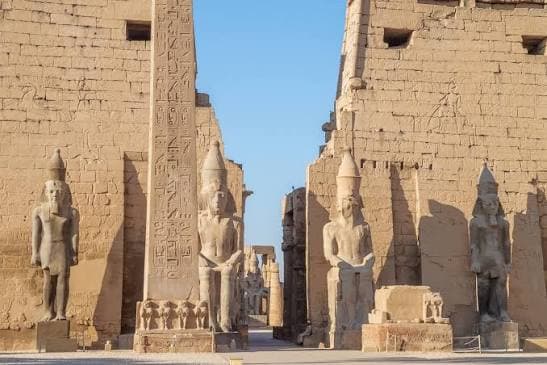
Archaeological recordLuxor, Egypt · c. 1400 BCE, expanded by Ramesses IIAncient Egyptian
Luxor Temple
c. 1400 BCE, expanded by Ramesses II · New Kingdom temple complex
The story
A vast temple on the east bank of the Nile in ancient Thebes, raised mainly by Amenhotep III and enlarged by Ramesses II, Tutankhamun and Horemheb. Unlike most Egyptian temples it is not dedicated to a god but to the rejuvenation of kingship, and each year the Opet festival carried a cult statue of Amun from Karnak down the Nile to stay here.
The record
01
Built
c. 1400 BCE, expanded by Ramesses II
02
Era
Ancient Egyptian
03
Style
New Kingdom temple complex
04
City
Luxor, Egypt
Why it matters
01Built chiefly by Amenhotep III around 1400 BCE and expanded about a century later by Ramesses II
02Its great colonnade and entrance pylon were added by Ramesses II, who flanked the gateway with colossal seated statues
03One of the pair of obelisks that once stood at the entrance now marks the Place de la Concorde in Paris
Egypt Landmark Finder demonstrates how multi-pass generative vision and grounded verification can accurately identify historical monuments and heritage sites across Egypt, distinguishing architecturally similar and co-located structures.
Business Applications
1
Cultural Tourism & Smart Guides
Instant real-world recognition enables interactive museum and tourist guides, enriching visitor experiences with contextual history, architectural style, and construction periods.
2
Heritage Preservation & Asset Cataloging
Assists archaeological surveys and cultural ministries in digitizing, cataloging, and verifying architectural landmarks in the field.
High-Level Technical Workflow
1
Image Ingestion & EXIF / GPS Parsing
The uploaded photo is processed to extract visual features and optional GPS coordinates to anchor the search region.
2
Multi-Pass Vision Analysis & Candidate Retrieval
Gemini vision analyzes architectural features, motifs, and surroundings, proposing candidate landmarks from a curated Egyptian heritage catalog.
3
Grounded Verification & Historical Synthesis
Candidates undergo strict cross-verification against verified encyclopedic sources to eliminate false positives and produce detailed architectural metadata, historical timeline, and nearby attractions.